The Book
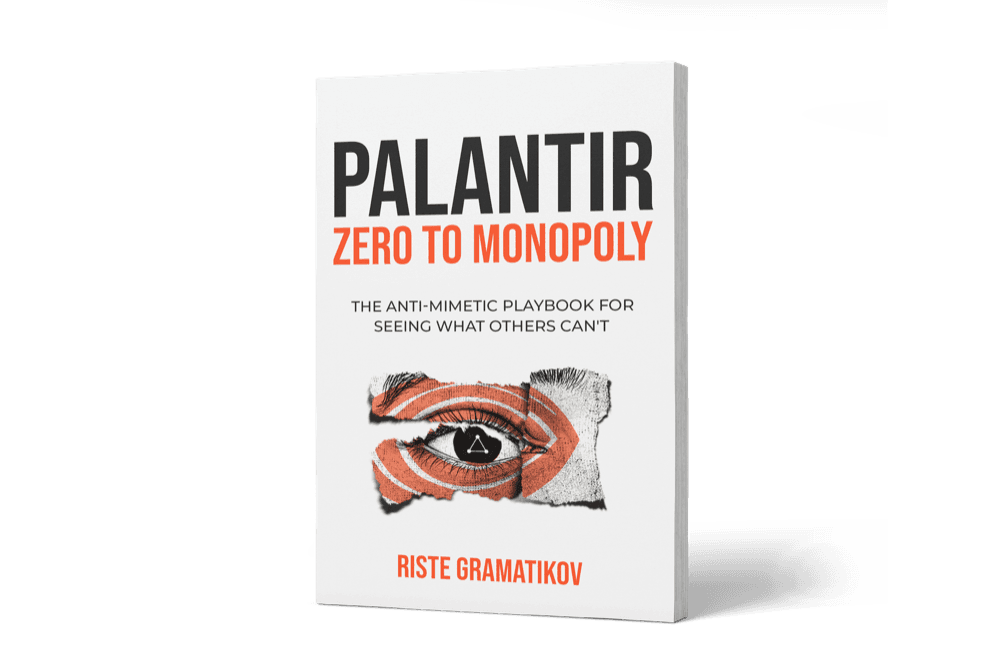
PALANTIR
ZERO TO MONOPOLY
Ten chapters tracing the complete system — from Peter Thiel's contrarian founding insight to the double monopoly Palantir has built in enterprise AI. For investors, enterprise leaders, and founders who want to understand the operating model, not just the stock.
10
Chapters
Free
Preface online
Free
Appendix online
Chapter Breakdown
Every chapter maps to a failure mode.
The book is structured around the five reasons enterprise transformations fail. Each chapter provides both the diagnosis and the mechanism Palantir built to solve it.
Preface
Preface
Why Enterprise Transformation Fails
57–84% of enterprise transformations miss their targets (BCG, McKinsey). The root cause isn't lack of talent or resources — it's mimetic behavior: organizations unconsciously copying what peers do instead of what works. Palantir has solved this. Three observable signals: 8× Google's unicorn founder production rate, a 127% Rule of 40 score, and every major competitor copying the FDE model.
- Five failure modes: weak executive sponsorship, unclear case for change, poor change management, weak governance, insufficient capability
- René Girard's mimetic theory as diagnostic tool for organizational failure
- How each chapter maps to one of the five failure modes
Part I: The Foundation Story
Chapter 1
Failure Mode 1: Unclear Case for Change
From Philosophical Question to Strategic Framework
Most analysis starts with Palantir's products. This chapter starts earlier — with the post-9/11 question Peter Thiel asked: can privacy and security reinforce each other? That insight, drawn from Girard's mimetic theory and PayPal's fraud detection, became the architectural principle behind everything Palantir built. Karp's Frankfurt School training kept the thesis intact under pressure — four examples show how. Sankar became the living proof: the engineer shaped by the culture. The customer selection criteria that followed (high stakes, non-tech-savvy, integration-resistant) were direct consequences of the founding insight.
- Girard's mimetic theory in depth: mimetic desire, rivalry, scapegoat mechanism, and the contrarian question as escape method
- Karp's four examples of preventing drift: FDE model, talent systems, communication patterns, governance as architecture not policy
- Three-factor customer selection → uncontested market space + world-class operator feedback + outcome-based pricing
Part II: The Complete Culture System
Chapter 2
Failure Mode 2: Weak Executive Sponsorship
Anti-Mimetic First Principles
Three operating principles, extracted from Palantir's actual behavior rather than its marketing. Reality as the Referee: evidence over opinion, banning social proof as justification. Disagreement as Duty: entry-level engineers arguing with directors on open email chains, minority opinions formally documented. Systems Over Scapegoats: Five Whys applied to culture failures, not just bugs. These principles are not aspirational values — they are structural mechanisms that produce measurable outcomes.
- "Are you winning? Do more of that." — Shyam Sankar on Reality as the Referee
- How institutionalizing dissent prevents it from depending on naturally contrarian individuals
- Norm Kerth's Prime Directive as the foundation for psychological safety at scale
Chapter 3
Failure Mode 5: Insufficient Capability
Organizational Implementation
Two roles, two methodologies, one diagnosis. The Deployment Strategist applies institutional user research (Steve Portigal's interviewing methodology) to uncover what organizations actually need — observing workarounds, reframing stated requirements, owning outcomes end-to-end. The Forward Deployed Engineer applies reliability engineering (Fault Tree Analysis, 5 Whys) to build production systems under operational pressure — operating like a startup CTO for each customer's problem. Together they form mission-autonomous cells of 4–8 people organized around problems, not functions. The chapter introduces MidWest Manufacturing — a fictional automotive company facing a brake recall crisis across 500,000 vehicles with $700M exposure — as the case study that runs through the rest of the book.
- BD-PD symbiosis: forward-deployed pain systematically becomes platform features (manual integrations → SDDI)
- DS methodology: Portigal's user research adapted for institutional transformation; FDE methodology: reliability engineering under pressure
- MidWest case study introduced: 48-hour implementation, 4-hour investigation → 30-second query, $400M recall savings
Chapter 4
The Complete Talent System
Palantir couldn't compete on FAANG compensation. So it turned its constraints into filters: defense work, public controversy, below-market pay, and FDE role ambiguity each repel mercenaries and attract missionaries. What emerged wasn't a workaround — it was a superior selection mechanism. The full system spans eight components from hiring (campus recruiting at scale) through development (gamma rays, superpowers, artist colonies) to retention — and every component reinforces every other.
- Auftragstaktik (mission command): four substitutes for traditional management
- The accidental filter that became the bat signal: why the hardest constraints attract the best candidates
- 8× Google's unicorn founder production rate as the measurable output of the integrated system
Chapter 5
Failure Mode 3: Poor Change Management
The Deployment Discipline
Enterprise transformations stall because deployment teams trigger the organizational immune response — resistance rooted in threatened authority, expertise, and position. Keith Johnstone's Impro maps directly onto deployment work: Status (reading what the enterprise is protecting), Spontaneity (responding to resistance without blocking — accepting the offer rather than defending the plan), and Narrative (reincorporation as the mechanism for building trust). All three skills are demonstrated through MidWest Manufacturing deployment scenarios — a compliance officer guarding audit procedures and a process engineer threatened by automation.
- The see-saw: surface objections are technical; real resistance is about authority, expertise, position
- Blocking vs. accepting: every constraint, objection, and accident is an offer
- Reincorporation as trust-building: closing every loop you open is how credibility compounds
Chapter 6
The Language of Anti-Mimetic Culture
Anti-mimetic culture needs to travel across hundreds of deployers without signal loss. Shyam Sankar solved this through three communication metaphors, each encoding one of the book's three principles in a form that resists dilution: Gamma Ray Growth (Reality as the Referee — grow through direct exposure to consequences), Artist Colony vs Factory (Disagreement as Duty — manage non-interchangeable people who push back), and Superpowers & Kryptonite (Systems Over Scapegoats — amplify strengths and design around weaknesses). The chapter frames the signal loss problem — how strategic vision degrades into bureaucratic noise through translation layers — and shows how these metaphors solve it.
- The signal loss problem: CEO's insight → middle management process → frontline bureaucracy
- Gamma rays, artist colony, superpowers: compression mechanisms that transmit philosophy without degradation
- Why values posters fail and metaphors work: encoding principles in forms that resist hollowing out
Part III: The Technical Product
Chapter 7
Failure Mode 4: Weak Governance
Foundry — The Decision Automation Platform
Foundry solves the gap between data and decisions through three integrated layers: the Digital Twin (ontology as a queryable business graph), Data Integration (SDDI — five cooperating subsystems that learn from every deployment), and Decision Automation (actions and automations that close the loop from insight to autonomous operation). The chapter introduces the Five Levels of Enterprise Autonomy, then demonstrates progression through the MidWest Manufacturing case across three acts — from 4-hour brake recall investigation compressed to 30 seconds (Act 1), to automated hold of 127 vehicles when a furnace runs hot (Act 2), to 95% of routine quality decisions automated entirely (Act 3).
- SDDI: Bundle Finder, Key Finder, Path Chooser, Column Namer, Feedback Logger — compound learning at the integration layer
- The ontology: objects, links, and properties that make data speak business language
- Sarah Chen's time: 60 hrs/week (Act 1) → 15 hrs/week (Act 2) → 3 hrs/week (Act 3)
Chapter 8
AIP — Accelerating Foundry Deployment
MidWest's 18-month Foundry journey compressed to 3 months. The bottleneck was not Foundry's capabilities — it was FDE configuration time. AIP makes configuration conversational. The critical distinction: LLMs operate at the input layer (extracting unstructured data) and interface layer (natural language queries). Intelligence lives in Foundry's automations, ML models, and business logic. The same 500 FDEs handle 2,000 deployments per year instead of 335.
- Mode 1 (pure orchestration) vs. Mode 2 (constrained code generation) and why the distinction matters
- Foundry's three guardrails that prevent generic LLM failure: ontology, Actions framework, human-in-the-loop
- Acceleration compounds: SDDI (12–18×) × Automations (16×) × Applications (10–15×) × ML (9–10×)
Part IV: The Compound Effect
Chapter 9
The Enterprise App Store — Compound Learning at Scale
66+ production-ready applications at aip.palantir.com — current reality, not future vision. MidWest Manufacturing becomes a template for MedTech Innovations: 95% SDDI reuse, 90% ontology reuse, 85% automation reuse, 3 weeks instead of 18 months. The compound learning flywheel means every deployment gives and receives: procurement fraud detection patterns from financial services deployed at a manufacturer in 2 weeks instead of 6 months, aviation predictive maintenance logic applied to factory equipment in 3 weeks instead of 8 months.
- Vertical platforms (Warp Speed for manufacturing, Skywise for aviation) vs. horizontal templates (procurement, supply chain)
- Bidirectional learning: MidWest both contributes templates and imports them from other industries
- Network effects: more deployments → better templates → faster implementations → more customers
Part V: The Conclusion
Chapter 10
The Double Monopoly
Two monopolies reinforcing each other. Palantir's platform monopoly: compound learning → 66+ application templates → network effects → switching costs. The customer operational monopoly: MidWest now operates at speeds its competitors cannot replicate — 30-second root cause analysis, automated supplier monitoring, 95% of routine decisions automated, $289M in annual operational advantages. New entrants face a structural catch-22: you need compound learning to compete, but you need deployments to build compound learning.
- Why foundation model companies cannot leapfrog Palantir: the access, trust, context, and infrastructure problems
- Rule of 40: Q3 2022 at ~35%; Q4 2025 at 127% — more than triple the enterprise software industry average
- 95% of enterprise GenAI pilots fail to achieve measurable P&L impact (MIT NANDA, 2025) — the 5% divergence
Free Online
The full technical appendix is published here.
Five sections of deep technical content — the annotated DS interview, SDDI architecture, ontology object definitions, Actions and Automations specs, and complete AIP implementation walkthroughs. Free, indexed, and searchable.
Explore the Appendix →Get in Touch